
To schedule a free phone consult please follow the link here

Why Some Children Struggle to Make Friends (And How Communication Plays a Bigger Role Than You Think)
Author: McKenzi Donahue B.S. SLP-A (Check Out Her Staff Page Here)
Watching your child make friends can be one of the sweetest parts of the early years. Whether they are running around together on the playground, building a tower at preschool, or simply sitting next to another child and sharing toys, these early friendships are an important part of growing up.
But for some children, making friends does not come quite as easily.
When we think about a child having difficulty making friends, we might assume they are simply shy or need more opportunities to be around other children. Sometimes, though, the challenge may have less to do with wanting to make friends and more to do with the communication skills needed to successfully interact with them.
Communication is about much more than how many words a child can say. Children also use communication to enter play, take turns, share ideas, understand emotions, solve disagreements, and keep an interaction going. These skills are often referred to as social communication or pragmatic language skills.
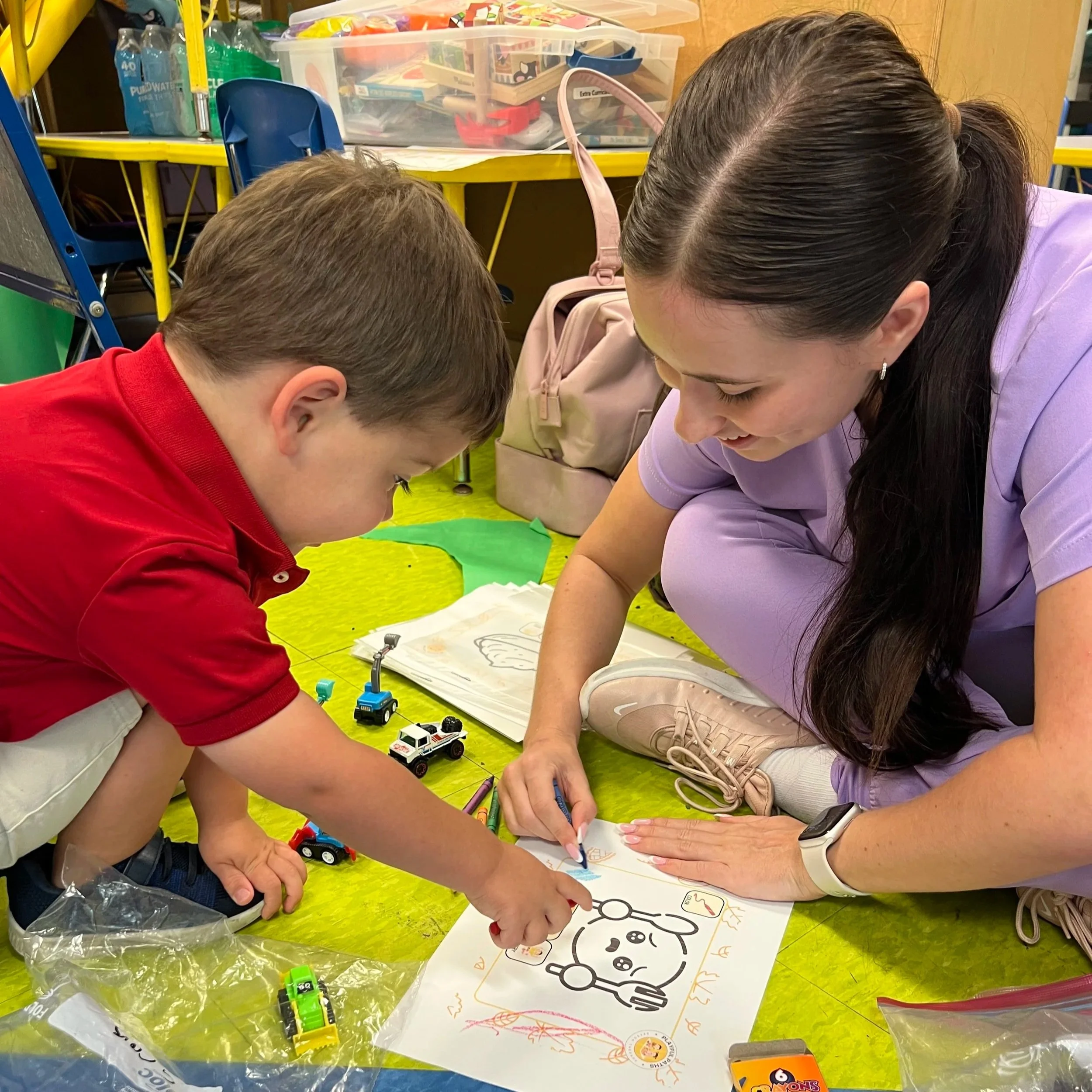
Friendship Requires a Lot of Communication
Think about what happens when a young child walks onto a playground and wants to play with another child.
They may need to:
Approach another child
Get their attention
Ask to join the activity
Understand what the other child is doing
Take turns
Share toys or materials
Respond to what the other child says or does
Notice facial expressions and body language
Handle hearing “no” or waiting for a turn
Solve a problem when the play does not go as expected
That is a lot happening at once!
For young children who are still developing their speech, language, or social communication skills, these interactions can sometimes feel difficult.
The CDC includes several social and communication behaviors within developmental milestones for young children. For example, by age 4, many children are beginning to ask to play with other children, engage in pretend play, comfort someone who is hurt or sad, talk about something that happened during their day, and answer simple questions. The CDC also recommends helping children learn skills such as using words during play, sharing toys, and taking turns.
Social Language Is More Than Talking
A child can have a large vocabulary and still have difficulty knowing how to use language socially.
Social communication includes knowing how to use communication for different purposes and situations. During play, this might look like saying:
“Can I play?”
“My turn!”
“Look what I made!”
“Can I have that when you're done?”
“Let's build a castle!”
Children are also learning how to listen and respond to what another person says. A successful conversation is a back-and-forth interaction rather than one person doing all of the talking.
ASHA emphasizes that communication development occurs over time and that children develop at different rates. Families can support development through everyday interactions such as talking about what they are doing, responding to their child, and exposing children to a variety of words and conversations.
Turn-Taking Starts Before Conversation
Turn-taking is one of the foundations of communication, and children can practice it long before they are having full conversations.
Rolling a ball back and forth, stacking blocks one at a time, blowing bubbles and waiting for another person to pop them, or taking turns adding pieces to a puzzle all teach an important idea:
My turn, then your turn.
That same pattern eventually carries over into conversations. One person communicates, the other responds, and the interaction continues.
Even simple back-and-forth games can provide valuable opportunities for children to practice waiting, watching another person, responding, and taking their turn.
Playground Skills Are Communication Skills Too
The playground is full of opportunities for social communication.
A child may have to figure out how to ask for a turn on the slide, join a game of tag, tell another child to stop doing something they do not like, or negotiate who gets to use a favorite toy.
These situations require language, emotional regulation, problem-solving, and perspective-taking all at once.
The American Academy of Pediatrics encourages parents to be available during young children's play and provide guidance with skills such as sharing and resolving conflicts. These early play experiences can also give parents a chance to notice their child's social strengths and areas where they may need additional support.
How Parents Can Help
The good news is that social communication skills can be practiced during everyday activities. You do not need flashcards or a complicated lesson plan.
1. Practice simple friendship phrases.
Give your child words they can use before they need them.
Try practicing:
“Can I play?”
“Do you want to play?”
“Can I have a turn?”
“Help me, please.”
“Let's do it together.”
When children have practiced the language ahead of time, it may be easier to use it during an actual interaction.
2. Play turn-taking games.
Simple games such as rolling a ball, building with blocks, completing puzzles, or playing with bubbles are great opportunities to practice “my turn” and “your turn.”
3. Use pretend play.
Pretend that stuffed animals are meeting at the playground or that two toy characters want the same toy.
Ask questions like:
“What could he say?”
“How can she ask for a turn?”
“What should they do next?”
Pretend play gives children a safe place to practice situations they may encounter with peers.
4. Talk about emotions.
Help your child notice how other people may be feeling.
You might say:
“She looks sad. What could we do?”
“He looks excited!”
“I think she is frustrated because she is still waiting for a turn.”
Learning to recognize emotions can help children better understand and respond to their friends.
5. Give them time to respond.
Adults naturally want to jump in and help when a child is struggling. Sometimes, waiting a few extra seconds gives a child the opportunity to initiate, respond, or solve a social problem independently.
You can always step in and model language if they need help.

Download our age appropriate check lists to give you a better idea about whether or not to reach out.
When Making Friends Feels Hard
Not every child who is quiet on the playground has a communication difficulty. Some children need more time to warm up, and every child develops differently.
However, if your child consistently wants to interact with other children but seems unsure how to join them, has difficulty maintaining back-and-forth interactions, frequently struggles with turn-taking or understanding social cues, or becomes frustrated because they cannot communicate effectively with peers, it may be helpful to pay closer attention to their communication development.
ASHA notes that developmental milestones can help families understand what communication skills typically emerge across different age ranges, although milestone lists themselves are not diagnostic tools.
A speech-language pathologist can look beyond how clearly a child speaks and evaluate how they understand, express, and socially use language.
The Big Picture
Friendship may look like play, but underneath that play are dozens of communication skills developing at the same time.
Children are learning how to say hello, ask questions, take turns, understand feelings, share ideas, solve problems, and advocate for themselves.
Supporting those skills does more than help children become better communicators.
It helps give them the tools they need to connect with other people.
References
American Academy of Pediatrics. (n.d.). What parents can do to support friendships.
https://www.healthychildren.org/English/family-life/power-of-play/Pages/What-Parents-Can-Do-to-Support-Friendships.aspx
American Speech-Language-Hearing Association. (n.d.). Communication milestones: Age ranges.
https://www.asha.org/public/developmental-milestones/communication-milestones/
Centers for Disease Control and Prevention. (2026). Milestones by 4 years.
https://www.cdc.gov/act-early/milestones/4-years.html
Centers for Disease Control and Prevention. (2026). Developmental milestones.
https://www.cdc.gov/act-early/milestones/index.html