
To schedule a free phone consult please follow the link here

School Vs. Private Speech Therapy Services
Author: Isabella Knight M.S. CCC-SLP (Check Out Her Staff Page Here)
School-based speech therapy and private speech therapy can both be valuable, but they may serve different purposes, follow different processes, and may look different depending on the child’s needs.
School speech therapy is designed to support a student’s ability to access and participate in their education.
Private speech therapy is designed to evaluate, diagnose, and treat communication needs across daily life, home, school, and community settings.
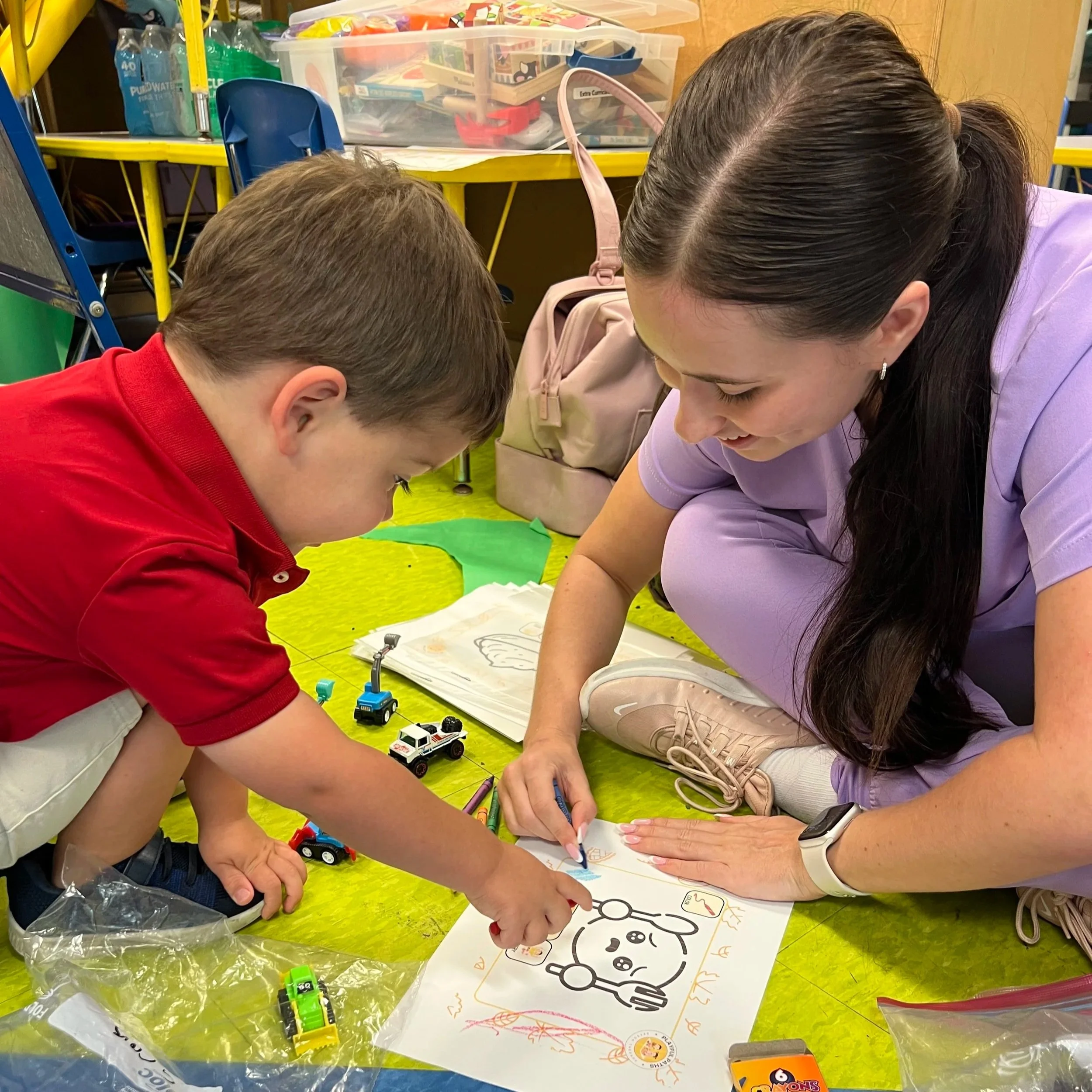
School Speech Therapy Services
In the school setting, the child is typically referred to as a “student.” School-based services usually begin with a referral or screening for a student based on teacher or school staff concerns for speech and/or language skills. Following a screening, the student will undergo a tiered framework of interventions. This could include short-term speech or language strategies, small group practice, teacher support, or progress monitoring. The goal is to see how the child responds when they are given extra help. During that time, the team collects data to see if the child is improving. If the child makes good progress, they may not need formal speech therapy through an IEP. If the child continues to struggle with the additional support, the team may consider whether a full speech and language evaluation is needed.
The evaluation process is the next step where the school team gathers information about the student’s communication skills, strengths, and weaknesses. In the school setting, services are based on whether the student’s communication needs impact their ability to access, participate in, or make progress in the educational environment.
If the student qualifies, the team holds an eligibility meeting to determine whether the student meets criteria for school-based services. A student is found eligible for services due to educational impact rather than being given a medical diagnosis.
After eligibility is determined, an IEP meeting is held where the team develops an Individualized Education Program, or IEP, which may include accommodations, speech therapy goals, and service minutes.
Services are usually provided by the school or district speech-language pathologist individually, in a group, outside of the classroom, or through push-in support within the classroom. The SLP may also collaborate with teachers and other school staff to support the student’s communication needs throughout the school day.
Private Speech Therapy Services
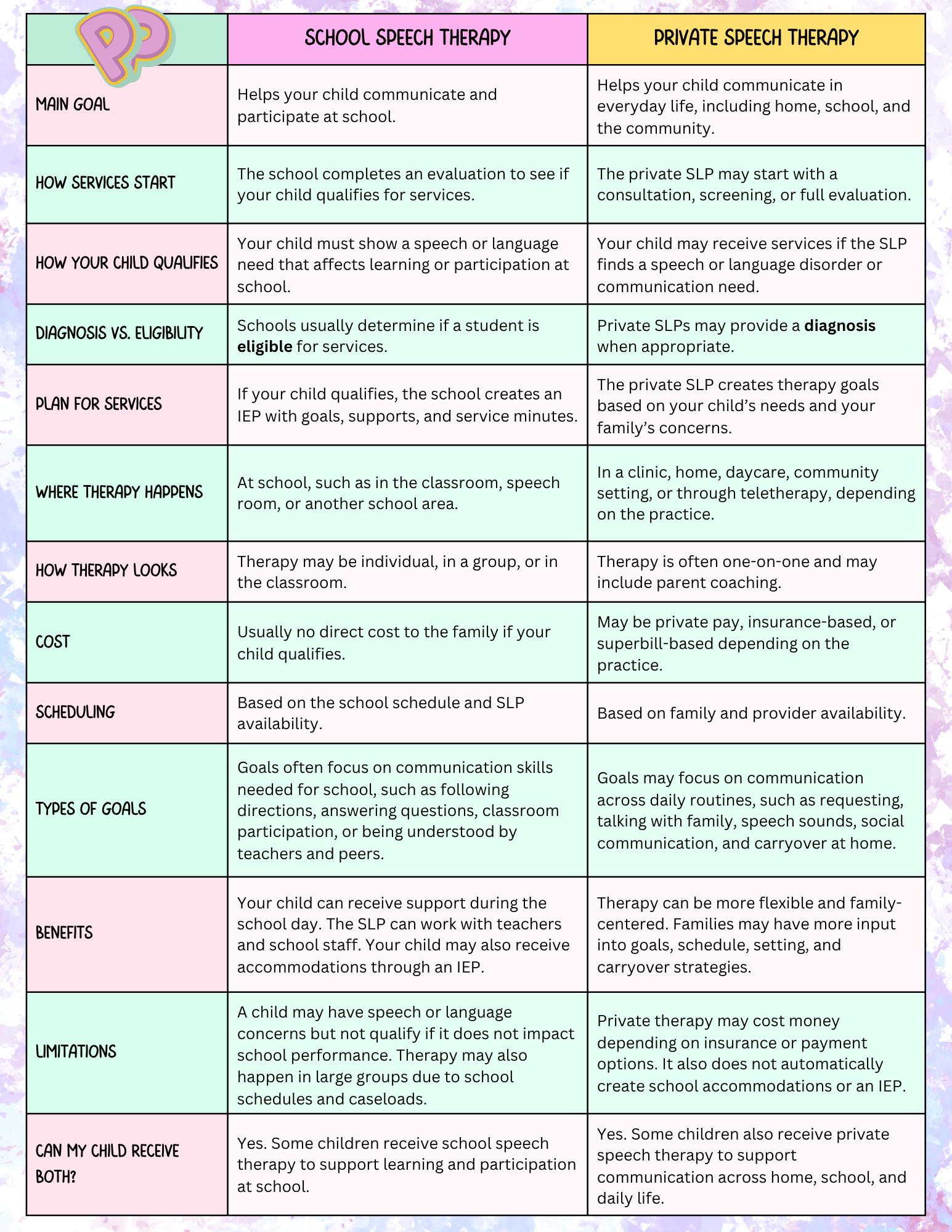
Download our School Vs. Private Speech Therapy Infographic.
In private practice, the child is typically referred to as a “client” or “patient.” A private speech-language pathologist may complete a consultation or screening to determine if the child needs an evaluation. A full evaluation is completed to determine whether the child has a speech and/or language disorder. In this setting, the SLP may provide a clinical diagnosis when appropriate.
After the evaluation, therapy goals are created based on the child’s needs and family priorities, and a therapy schedule may then be recommended or offered. Private therapy may take place in a clinic, home, daycare, community setting, or through teletherapy, depending on the practice and what is appropriate for the client and family. Some private practices bill insurance, while others are private pay or provide superbills for possible reimbursement.
Private SLPs may also collaborate with families, teachers, pediatricians, occupational therapists, physical therapists, mental health providers, or other professionals involved in the child’s care.

Download our age appropriate check lists to give you a better idea about whether or not to reach out.
Pros and Cons
School Speech Therapy
Pros:
Often no cost to the family if the student qualifies.
The student may also receive accommodations and supports through an IEP.
The SLP is able to collaborate with teachers and staff who see the student in the educational environment.
Cons:
School-based services are determined by educational need, so a child may have speech or language difficulties but not qualify if those needs are not shown to impact school performance.
Therapy may also be provided in small or large groups, and scheduling is often limited by the school day, classroom demands, meetings, evaluations, and the SLP’s overall caseload.
School goals may be more academically focused (i.e., classroom participation, academic language, intelligibility in school, following directions, answering questions) rather than family- and client-centered.
Private Speech Therapy
Pros:
Services may focus on communication needs across home, school, and daily life.
Families may have more input into goals, scheduling, setting, and frequency of services.
Private therapy can offer more direct parent coaching and carryover strategies for home and community routines.
1:1 therapy sessions.
A child may not qualify for school-based services but may still benefit from private speech therapy, especially if concerns are affecting communication at home, in social settings, or in daily routines.
Cons:
Private speech therapy may be an out-of-pocket expense, depending on the practice and insurance coverage.
Scheduling may depend on provider availability and family availability.
Private therapy also does not automatically create school accommodations or an IEP.
Both school-based and private speech therapy can be valuable. School speech therapy focuses on helping a student access and participate in their education, while private speech therapy can address a child’s communication needs across home, school, and community life. Some children receive both school-based and private speech therapy. These services can work well together because they support the child in different ways and, when appropriate and with parent permission, private and school-based SLPs may communicate to support consistency across settings.
References
American Speech-Language-Hearing Association. (n.d.). Continuum of service delivery options in school-based speech-language pathology services. https://www.asha.org/slp/schools/continuum-of-services/
American Speech-Language-Hearing Association. (n.d.). School-based service delivery in speech-language pathology. https://www.asha.org/slp/schools/school-based-service-delivery-in-speech-language-pathology/
Florida Association of Speech-Language Pathologists and Audiologists. (n.d.). School-based services vs. private practice. https://www.flasha.org/page/sbsvpp