
To schedule a free phone consult please follow the link here

Start Doing This to Know if Your Child or Teenager’s Speech Delay Is “Just in Your Head”
Many parents carry a quiet worry about their child’s speech. It shows up in fleeting thoughts like “Other kids seem to talk more” or “Maybe I’m expecting too much.” Often, those concerns get brushed aside by reassurance from well-meaning adults or comments like “They’ll talk when they’re ready.”
Here’s the problem: intuition without evidence is easy to dismiss. But intuition paired with data becomes insight. One of the simplest and most effective things you can do is keep a one-month log of the words your child says.
This is not about diagnosing. It’s about noticing patterns.
What a 1-Month Speech Log Is (and Is not)
A speech log is not a milestone checklist.
It’s not a comparison to other children.
It’s not an evaluation.
It is a snapshot of real language used in real life.
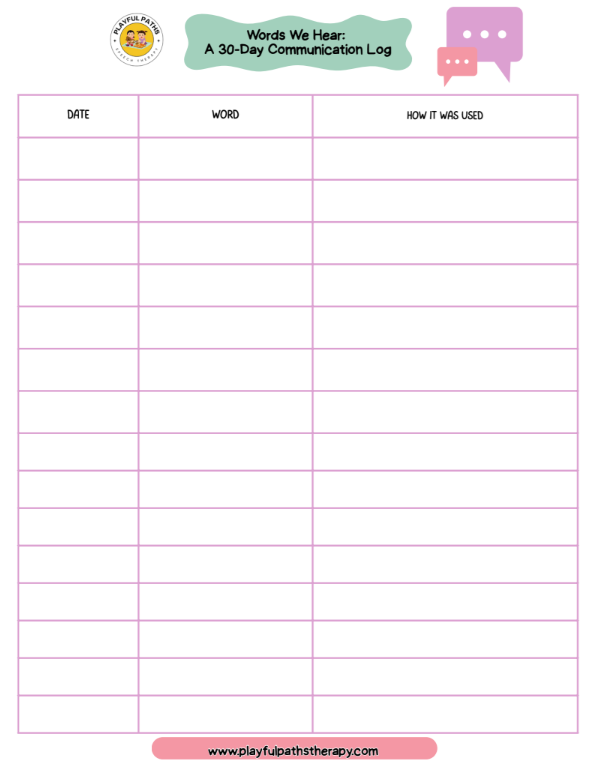
For 30 days, you write down every word your child uses spontaneously and consistently. (Download the 30 Day Communication Log Here or by clicking the download button underneath the 30 Day Communication Log to the right)
This approach aligns with what speech-language pathologists call language sampling, a widely accepted method for observing expressive language in natural contexts rather than artificial testing situations (Paul & Norbury, 2012).
What Counts as a Word?
Parents often overthink this part. Keep it simple and observational.
Clear spoken words (for example: “mama,” “go,” “up”)
Consistent word attempts (for example: “ba” used every time for ball)
Words or phrases used with clear intent, such as while pointing, reaching, or looking
Repeated phrases when you note where they came from and how they were used
Count:
“Let it go” (song lyric, used to protest)
“Ready, set, go!” (TV show phrase, used before sliding)
“We’re going on a bear hunt” (book line, used during play)
Examples:
Sounds said once and never again
Words only produced after heavy prompting
Do Not Count:
Your child says “da” one time while playing and never uses it again
A random sound like “eee” or “gah” heard once during the day with no repeat
A syllable said while babbling that doesn’t show up again later
These sounds are part of vocal exploration, not yet meaningful communication.
Sounds said once and never again:
Examples:
Words only produced after heavy prompting:
Your child only says “ball” after you say, “Say ball… baaaall”
A word spoken only after repeated cues like “What is it? Say it. You know this.”
A word that appears only when directly asked, but is never used on its own
These attempts show learning is starting, but the word is not yet being used independently.
How to Track Without Burning Out
The best system is the one you’ll actually use.
Parents often choose:
A notes app on their phone
A small notebook kept in the kitchen
A simple dated list on paper (many families keep it on a clipboard on the fridge or wall)
Write the date next to each new word. You only log a word once, even if it’s used repeatedly.
Jan 3 – “go”
Jan 6 – “bye”
Jan 14 – “more”
Jan 22 – “up”
That’s four words added in one month. No judgment. Just information.
Example log:
What to Look for After 30 Days
At the end of the month, review the list and ask:
Did new words emerge?
How frequently?
Are words used across different situations?
Is progress steady, slow, or flat?
Research shows that vocabulary growth is a strong early indicator of later language development (Fenson et al., 2007). A consistently flat or minimal increase can signal the need for further support.
Example:
If your child started the month with 10 words and ended with 11, that’s different information than ending with 25. Neither means failure, but they suggest different next steps.
Why This Matters More Than You Think
Parents are often told to “wait and see,” yet studies consistently show that early identification and intervention lead to better language outcomes (Roberts & Kaiser, 2011).
A speech log:
Turns vague worry into observable patterns
Gives pediatricians and therapists concrete data
Helps parents advocate with confidence
Most importantly, it helps you trust yourself.
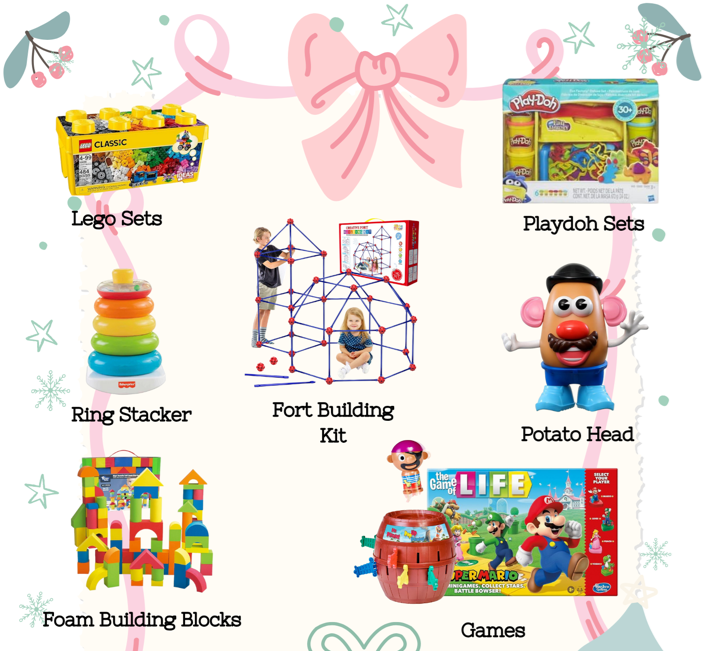
See our page of SLP reviewed and approved toys, books, and more!
A Gentle Reframe
Keeping a log doesn’t mean something is wrong. It means you are paying attention. And attention is the foundation of support.
If, after a month, you’re still unsure, that uncertainty is valid. You don’t need a crisis to justify asking questions. Early support is not about labels. It’s about access.
You’re not imagining things.
You’re noticing your child.
And that is exactly where good support begins.
References
Fenson, L., Marchman, V. A., Thal, D. J., Dale, P. S., Reznick, J. S., & Bates, E. (2007). MacArthur-Bates Communicative Development Inventories: User’s guide and technical manual (2nd ed.). Brookes.
Paul, R., & Norbury, C. F. (2012). Language disorders from infancy through adolescence (4th ed.). Elsevier.
Roberts, M. Y., & Kaiser, A. P. (2011). The effectiveness of parent-implemented language interventions: A meta-analysis. American Journal of Speech-Language Pathology, 20(3), 180–199.